

Fast, Reliable Air Quality & Sanitizing Across West New York
Air quality and sanitizing in West New York typically costs $280–$650 per treatment depending on system size and contamination level, with most apartment building jobs completed in a single visit. We’re across the river in Yonkers and regularly cross the George Washington Bridge or Lincoln Tunnel to reach West New York properties within 45 minutes during business hours. Our Air Quality & Sanitizing team knows the 07093 zip code well — from the brick mid-rises along Bergenline Avenue to the newer towers on Boulevard East overlooking the Hudson. Ryan Bell, our owner and lead technician, has spent eight years working on the exact duct configurations found in West New York’s dense apartment stock: centralized handlers, riser-based supply systems, and shared return plenums that demand a completely different approach than suburban single-family homes.
Why Redwood Air Duct Cleaning Service Yonkers Is West New York’s Preferred Air Quality & Sanitizing Company
West New York property managers and condo boards call us because we’re familiar with what fails in their buildings — not guessing based on suburban house experience. We’ve earned a 4.9-star average across 1,005 verified reviews, one of the highest review volumes in the regional air duct cleaning category, and that accountability carries across the Hudson on every job.
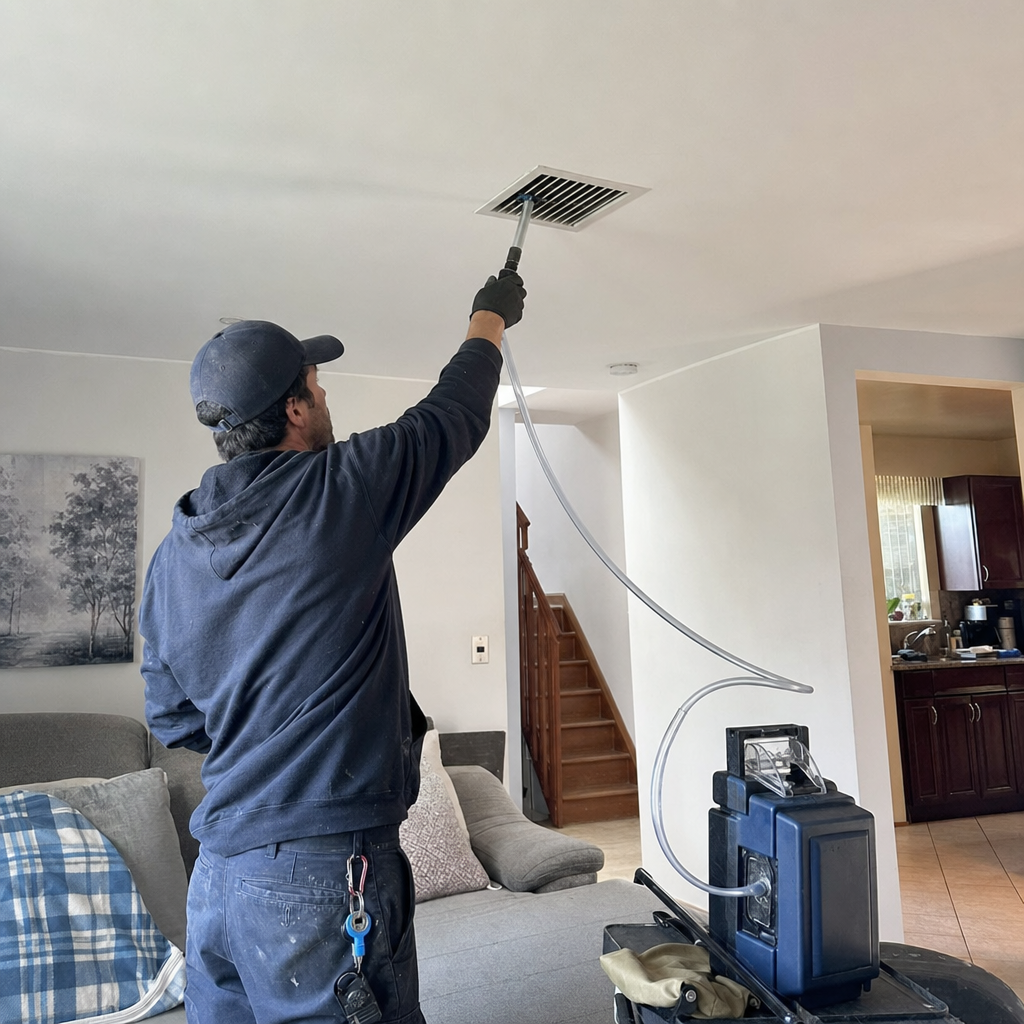
Our response time to West New York averages under an hour from initial call to technician arrival, because we know that mold blooms in shared duct systems don’t wait. Ryan Bell personally handles the assessment and treatment — the same person who answers your questions holds the Rotobrush equipment and installs the Honeywell or Aprilaire components. No subcontractor handoffs, no rotating franchise crews who need directions to Bergenline Avenue.
We understand the local housing stock: 1950s-to-1980s brick mid-rises with aging riser systems, plus newer luxury buildings with modern equipment but identical exposure to Hudson salt air. That combination means we arrive knowing whether your building likely has uninsulated crawlspace ducts, galvanized seams prone to corrosion, or contemporary flex duct with condensation issues — and we adjust our sanitizing protocol before we step through the door.
Our Air Quality & Sanitizing Services in West New York
Mold Treatment
Mold treatment in West New York runs $320–$580 for typical apartment unit ductwork, with full-building riser treatments starting around $1,800 depending on floor count. The Hudson Palisades position of 07093 exposes buildings to persistent river-driven humidity, especially on the Boulevard East waterfront side, where salt-laden air accelerates biological growth inside ductwork even in buildings with relatively recent HVAC equipment. We serviced a 12-story apartment building on Boulevard East where salt spray and humidity had corroded the galvanized duct seams, allowing mold to flourish in the supply runs. Our crew installed a Honeywell UV light system downstream of the air handler and sealed all joints with mastic, then treated the ducts with a biocide solution from Abatement Technologies to kill existing growth. In older mid-20th-century buildings, uninsulated duct runs through unconditioned crawlspaces or shafts develop condensation that spreads to all zones on that riser — we map the full riser before treating any single unit.
Bacteria Sanitizing
Bacteria sanitizing in West New York typically costs $280–$450 per unit or $2,200–$3,800 for full-building treatment, with pricing driven by duct linear footage and access difficulty. The Lincoln Tunnel approach corridor along Bergenline Avenue means HVAC intakes continuously draw in diesel particulate and vehicle exhaust — some of the highest concentrations in New Jersey — creating a greasy, biologically active film inside ducts that standard cleaning won’t address. Our Nikro HEPA-extraction systems remove the debris layer first, then we apply EPA-registered sanitizing agents formulated for HVAC applications, not consumer-grade sprays that leave residues. Property managers on 60th Street and off Kennedy Boulevard East particularly notice this buildup during shoulder seasons when systems switch between heating and cooling, stirring dormant bacterial colonies into occupied spaces.
Odor Removal
Odor removal in West New York starts at $240 for localized source treatment and ranges to $520 for whole-unit duct deodorizing with thermal fogging or activated carbon application. The same diesel exhaust and salt-air combination that causes mold and bacteria problems also creates persistent chemical odors — that “tunnel smell” residents near Route 495 often describe — that embeds in duct insulation and recirculates indefinitely. We distinguish between source-based odors (dead rodents, cooking grease, previous smoke damage) and systemic odors (permeated insulation, contaminated return plenums), because the fix differs: source removal versus full duct replacement or advanced oxidation treatment. Buildings near the Port Imperial ferry terminal face an additional odor vector — marine diesel and harbor emissions — that we’ve developed specific protocols to neutralize.
UV Light Installation
UV light installation in West New York apartment buildings runs $380–$720 per air handler for Honeywell or Aprilaire systems, with multi-zone buildings requiring multiple units. UV-C lamps installed downstream of the coil and before the supply trunk kill airborne mold spores and bacteria that survive filtration — critical in West New York’s moisture-heavy environment where biological growth outpaces what filters alone can catch. In multi-unit buildings on Bergenline Avenue and throughout the 07093 zip code, we size UV systems for the actual airflow and duct velocity, not square footage alone, because shared riser systems move air differently than individual residential units. The field vignette from our Boulevard East job illustrates why this matters: the UV system prevented recurrence after we eliminated the active mold, because it addresses the spores that continuous Hudson humidity would otherwise allow to reestablish.
What happens when you call
- 1
A real person answersNo phone trees — you reach a local pro.
- 2
You get an upfront price rangeHonest numbers before anyone is dispatched.
- 3
A background-checked tech heads outLicensed & insured, dispatched right away.
- 4
You approve before work beginsNothing starts until you say go.
Trusted Brands We Service in West New York
We install and maintain air quality equipment from Honeywell, Aprilaire, and Abatement Technologies — the same brands specified by restoration professionals and commercial HVAC engineers. For West New York customers, this means we don’t order parts from a warehouse three states away; we stock UV lamps, HEPA cartridges, and sanitizing agents for same-day replacement when a building’s system needs immediate attention. Our Rotobrush rotary brush systems and Nikro HEPA vacuums handle the mechanical cleaning that prepares ducts for sanitizing, ensuring the biocides and deodorizers contact actual duct surfaces rather than a layer of accumulated debris. When Ryan Bell arrives at your Bergenline Avenue mid-rise or Boulevard East high-rise, he’s carrying the full toolkit — not calling for a parts run that delays your building’s air quality restoration.
Common Air Quality & Sanitizing Problems We See in West New York Homes
- Salt-laden humidity from the Hudson corrodes duct seams and insulation, breeding mold in supply runs even in buildings with recent HVAC equipment. The waterfront exposure on Boulevard East and the Palisades slope creates a microclimate where metal ducts degrade faster than identical systems just inland in North Bergen.
- Continuous diesel exhaust drawn from the Lincoln Tunnel approach clogs filters and coats duct interiors with greasy particulate, requiring more frequent sanitizing than in suburban towns. Buildings within two blocks of Route 495 or Kennedy Boulevard East typically need filter changes and duct assessment on compressed schedules.
- In older mid-20th-century buildings, uninsulated duct runs through unconditioned crawlspaces or shafts develop condensation and biological buildup that spreads to all zones on that riser. One compromised section on the third floor of a Bergenline Avenue walk-up can contaminate six units above and below.
- Newer luxury high-rises near the waterfront install sophisticated equipment but often undersize dehumidification capacity for the actual moisture load Hudson exposure creates. We’ve found biological growth in supply ducts of buildings less than ten years old because the design didn’t account for salt-air corrosion accelerating coil degradation and bypass humidity.
Pricing for Air Quality & Sanitizing in West New York, NJ
| Service | Typical Range in West New York | What Affects Cost |
|---|---|---|
| Mold treatment — single unit | $320–$580 | Contamination extent, duct access, riser involvement |
| Mold treatment — full building riser | $1,800–$4,500 | Floor count, riser quantity, containment requirements |
| Bacteria sanitizing — single unit | $280–$450 | Linear footage, debris level, sanitizing agent type |
| Bacteria sanitizing — full building | $2,200–$3,800 | Handler count, zone complexity, occupancy scheduling |
| Odor removal — localized | $240–$380 | Source identification, insulation involvement |
| Odor removal — whole unit | $380–$520 | Duct material, odor type, thermal fogging needed |
| UV light installation | $380–$720 per handler | Brand, lamp intensity, electrical access |
| Air purifier installation | $450–$890 | Unit capacity, duct integration, monitoring features |
West New New York’s building density and system complexity mean most jobs fall in the mid-to-upper range compared to suburban single-family pricing — but shared-riser treatment often costs less per unit than individual service calls would. We provide exact quotes after visual assessment, never phone guesstimates that change on arrival. Estimates are free. Call (844) 257-5251 to schedule Ryan Bell’s evaluation of your building’s specific duct configuration and contamination pattern.
We Also Serve Cities Near West New York
Our service radius covers the full Hudson County corridor: Guttenberg to the north, North Bergen inland, Weehawken south along the waterfront, and Union City to the west. Each municipality presents distinct air quality challenges — Weehawken’s Lincoln Tunnel ventilation structures, North Bergen’s industrial zones, Union City’s older housing stock — and we adjust our sanitizing protocols accordingly rather than applying a uniform treatment. If you manage properties across multiple Hudson County towns, one relationship with Redwood covers your full portfolio with consistent technician accountability.
Serving West New York, NJ — Our Local Coverage Area
We’re based in the West New York area and know this community well. Use the map below to see our service coverage — if you’re nearby, we can almost certainly help.
FAQs — Air Quality & Sanitizing in West New York
Three factors accelerate mold growth in 07093 ductwork: persistent Hudson-driven humidity that keeps surfaces moist, salt-laden air that corrodes protective coatings and exposes raw metal or insulation, and shared riser systems that spread spores from one compromised section to multiple units. Buildings on Boulevard East experience this most severely because unobstructed river exposure funnels moisture directly into rooftop and wall-mounted intakes. Call (844) 257-5251 and we’ll assess your specific building’s intake placement and duct insulation condition — estimates are free.
Yes, when properly sized and positioned. UV-C lamps installed at the air handler coil and supply plenum kill airborne mold spores and bacteria before they enter the riser distribution system — critical in Bergenline Avenue buildings where continuous occupancy makes full-duct replacement impractical. Effectiveness depends on matching lamp intensity to airflow velocity and ensuring the UV spectrum reaches all passing air; we calculate this from your handler specs, not guess. For an exact specification and quote for your building, call (844) 257-5251.
Diesel particulate from the Route 495 approach and tunnel ventilation structures deposits as a greasy, acidic film inside ducts and on filters, creating a nutrient layer that supports bacterial growth and reduces HVAC efficiency. Buildings within several blocks of the corridor — much of central West New York — typically need filter changes 30–40% more frequently than comparable inland properties and benefit from more aggressive sanitizing schedules. We identify this contamination pattern during assessment and specify appropriate filtration upgrades alongside cleaning. Call (844) 257-5251 to evaluate your building’s exposure level.
Odor removal targets volatile compounds causing smell — smoke, cooking grease, pet dander, chemical residues — using oxidation, adsorption, or source extraction without necessarily addressing living organisms. Mold treatment specifically targets fungal growth and spores with biocides, mechanical removal, and moisture control, which often eliminates associated musty odors as a side effect but follows a different protocol. In West New York, we frequently encounter both: mold growth creating odor, and diesel particulate creating separate chemical smell, requiring sequential or combined treatment. Ryan Bell determines the actual source before quoting — call (844) 257-5251 for assessment.
We can sanitize individual unit branch lines and returns, but if the main riser or plenum is contaminated, isolated treatment provides temporary relief at best — spores and odors will reenter from the shared system. We always inspect the common ductwork first and present options: branch-only treatment with riser assessment, or coordinated full-riser service with per-unit pricing that reduces cost for all participants. Many West New York condo boards and management companies use our assessment to schedule building-wide maintenance. Call (844) 257-5251 to discuss your building’s specific riser configuration.
Written by Ryan Bell, Owner at Redwood Air Duct Cleaning Service Yonkers, serving West New York and Hudson County since 2016.