

Fast, Reliable Air Quality & Sanitizing Across Ridgefield Park
Air quality and sanitizing service in Ridgefield Park typically runs $280–$650 depending on contamination severity, and most homes in the 07660 zip code can be scheduled within 24–48 hours. If you’re noticing musty odors, persistent dust, or worsening allergies in your Ridgefield Park home, the problem often starts in ductwork that was never designed for today’s air quality demands.
We’re Redwood Air Duct Cleaning Service, and our Air Quality & Sanitizing team makes the short trip from Yonkers to Ridgefield Park regularly. Ryan Bell, our owner and lead technician, knows the village’s housing stock inside out — from the 1920s capes along Grand Avenue to the two-family homes packed tight near the village center. We’ve spent eight years cleaning, sealing, and sanitizing duct systems in Bergen County’s most environmentally stressed pocket. Call (844) 257-5251 and we’ll give you a free, no-obligation estimate — usually same-day if you’re near Teaneck Road or Bergen Turnpike.
Why Redwood Air Duct Cleaning Service Yonkers Is Ridgefield Park’s Preferred Air Quality & Sanitizing Company
1,005 households have trusted Ryan Bell with their ductwork, and that 4.9-star average didn’t come from easy jobs. Ridgefield Park presents some of the toughest indoor air quality conditions in Bergen County — river-marsh humidity, highway particulate loading, and flood-damaged retrofit ductwork — and we’ve built our reputation by solving problems that standard cleaning crews miss.
When you book with us, Ryan is the person who shows up. Not a subcontractor. Not a rotating technician from a franchise dispatch center. The owner holds the equipment on every job, which means direct accountability and no phone-tag when you have questions about what we found in your system.
Our response time to Ridgefield Park is typically same-day or next-day because we’re coming from Yonkers — not dispatching from a warehouse in central New Jersey. We know the parking constraints around the village center, the one-way streets that slow down larger service vehicles, and which basement entrances in older homes require compact equipment. That local logistics knowledge translates to less waiting, less disruption, and work that actually gets finished in the time we quoted.
Our reviews from Ridgefield Park customers specifically mention the difference owner-led service makes: technicians who explain what they’re seeing, who show before-and-after footage from the duct camera, and who don’t treat “it’s always been dusty here” as acceptable. We’ve earned our rating by treating every home like the technical challenge it is — not running a vacuum hose and calling it done.
Our Air Quality & Sanitizing Services in Ridgefield Park
Mold Treatment
Ridgefield Park’s location between the Hackensack River flood plain and the Meadowlands highway corridor creates a dual contamination threat unique to this pocket of Bergen County: particulate-heavy outdoor air from Routes 1&9, 46, and NJ Turnpike feeders all converge within a mile, infiltrating aging duct systems, while repeated flood events introduce moisture directly into low-lying return-air vents. That combination — airborne particulate load plus mold risk — doesn’t exist in Bergen County towns even two or three miles inland.
We treat mold with EPA-registered sanitizer fog from Abatement Technologies, applied after mechanical agitation with our Rotobrush system removes physical buildup. In river-adjacent homes, we always inspect floor-level returns first — these are the entry points where floodwater and silty backwash entered during Hurricane Ida and Superstorm Sandy. A standard surface wipe won’t reach the colonies growing on the interior of metal duct runs; our process penetrates the full system.
On a recent call in the river-adjacent block of Bergen Turnpike — just a few hundred feet from the Hackensack — our crew pulled a return-air grille that had clearly taken on water during Ida. We ran a Rotobrush agitation, followed by a full fog with Abatement Technologies EPA-registered sanitizer, then sealed the floor-level boot with mastic and metal tape. The homeowner told us the musty smell vanished within an hour.
Bacteria Sanitizing
Bergen County’s humid summers are amplified in Ridgefield Park by proximity to the Hackensack River marshland, raising ambient humidity enough that condensation forms regularly inside older, uninsulated metal duct runs. That moisture doesn’t just cause mold — it creates an environment where bacteria can colonize dust deposits and circulate through your living space every time the blower cycles.
Our bacteria sanitizing protocol targets both the biological contamination and the moisture conditions that enable it. We apply hospital-grade disinfectant fog after HEPA vacuum extraction with our Nikro equipment, then assess whether duct sealing or insulation upgrades are needed to prevent recurrence. In Ridgefield Park’s 1920s–1950s housing stock, where ducts were retrofitted through cramped attic kneewalls and uninsulated basements, joint gaps and poor sealing are nearly universal — we fix those before declaring the sanitizing complete.
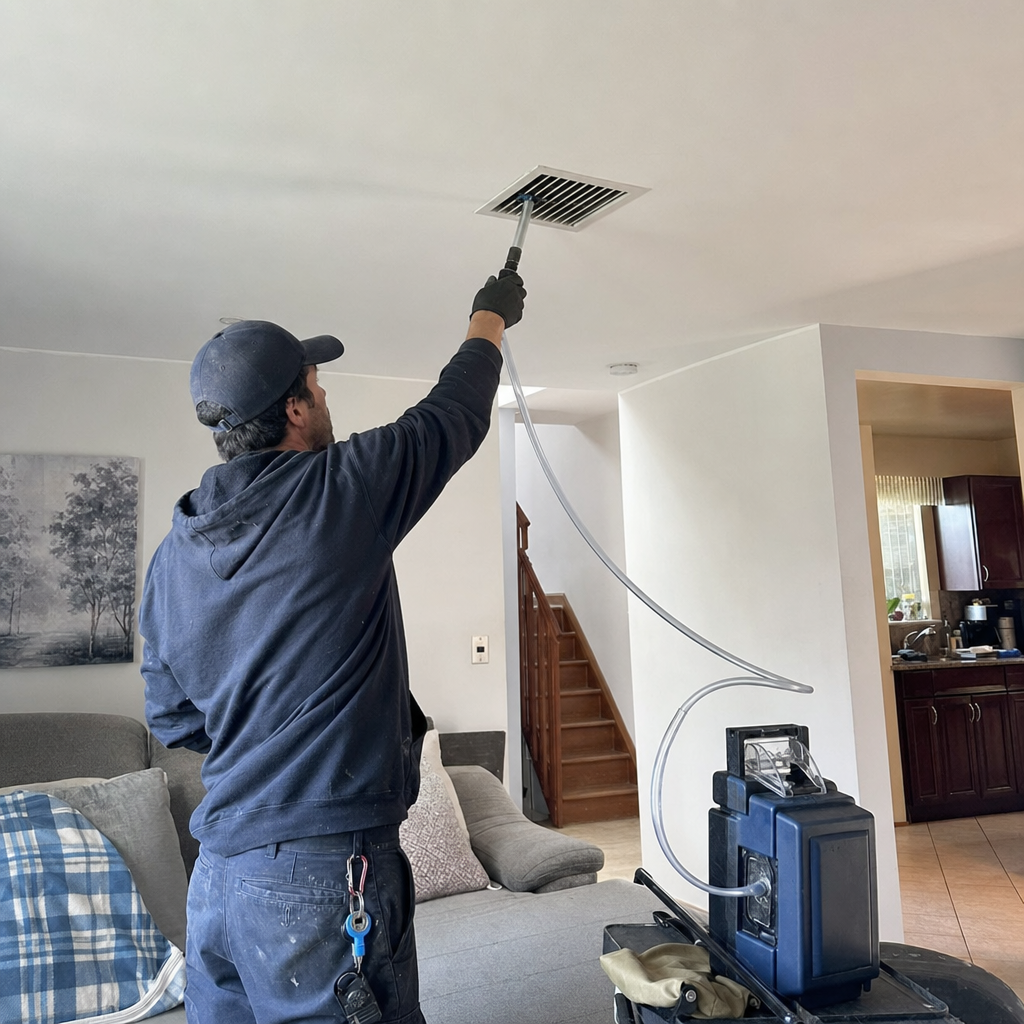
Odor Removal
Persistent HVAC odors in Ridgefield Park homes usually trace to one of three sources: flood sediment dried in floor-level returns, bacterial growth on moisture-laden dust, or highway particulate that has chemically bonded with organic material in the ductwork. Each requires different treatment, and we’ve learned to diagnose which is which from the character of the smell and the home’s location within the village.
Homes on lower streets near the river that took in water during Ida or Sandy often have dried sediment and rust staining that generic deodorizers can’t touch — the particulate has to be physically removed, then the metal treated with corrosion inhibitor before sanitizing. Homes closer to the highway corridor more often need particulate extraction followed by activated carbon treatment. We don’t mask odors; we eliminate the source and verify with post-treatment air sampling.
UV Light Installation
For Ridgefield Park homes with chronic moisture issues — especially those river-adjacent properties where humidity control is an ongoing battle — we install UV-C germicidal lamps at the coil and return locations. These aren’t consumer-grade plug-ins; they’re professional fixtures sized to your air handler’s dimensions, installed with proper shielding and ballast matching. We source through Honeywell and Aprilaire, brands that warranty their UV products for commercial applications, not just residential. Installation typically adds $180–$340 to a sanitizing service, and the lamps require annual replacement — something we handle on return visits without a separate dispatch fee.
What happens when you call
- 1
A real person answersNo phone trees — you reach a local pro.
- 2
You get an upfront price rangeHonest numbers before anyone is dispatched.
- 3
A background-checked tech heads outLicensed & insured, dispatched right away.
- 4
You approve before work beginsNothing starts until you say go.
Trusted Brands We Service in Ridgefield Park
We don’t show up with hardware-store equipment. Our Rotobrush rotary brush systems and Nikro HEPA vacuum extractors are the same tools used in commercial remediation work — not because we need that capacity for every job, but because Ridgefield Park’s contamination profile often exceeds what residential-grade equipment can handle. For air quality solutions, we specify Honeywell and Aprilaire filtration and humidification components, with Abatement Technologies air filtration for post-remediation verification. We stock replacement UV lamps, filter media, and sanitizer concentrate locally, so Ridgefield Park customers aren’t waiting on shipping when maintenance is due. That matters when you’re managing a property between tenants or preparing a home for sale in Bergen County’s competitive market.
Common Air Quality & Sanitizing Problems We See in Ridgefield Park Homes
- Uninsulated metal ducts sweating in river-marsh humidity. Ridgefield Park’s dense residential grid of 1920s–1950s capes and colonials was originally heated by steam radiators; forced-air ductwork retrofitted in the 1970s–1990s runs through attic kneewalls and uninsulated basements where condensation forms regularly. That moisture binds dust into a paste that standard cleaning can’t fully remove — and creates ideal conditions for biological growth that a dry-wipe leaves behind.
- Flood-damaged floor-level returns still harboring sediment. Homes on lower streets that took water during Hurricane Ida or Superstorm Sandy often had return-air grilles that pulled in floodwater or silty backwash. We regularly find dried sediment, rust staining, and active mold colonies in systems whose owners assumed the HVAC was unaffected. A simple pressure wash pushes debris deeper; our negative-pressure extraction with HEPA containment actually removes it.
- Inaccessible joint gaps in retrofit ductwork. The after-the-fact duct runs in Ridgefield Park’s two-family homes often have joints in cramped kneewall spaces that can’t be reached for proper sealing. When we fog sanitizer, those gaps leak treatment into unconditioned spaces instead of coating the duct interior. We seal aggressively with mastic and metal tape before sanitizing — otherwise you’re paying for product that never reaches the contamination.
- Highway particulate loading from the Meadowlands corridor. The convergence of Routes 1&9, 46, and NJ Turnpike feeders within a mile of Ridgefield Park means outdoor air here carries more diesel particulate, tire rubber, and brake dust than comparable Bergen County locations. That material infiltrates through poorly sealed return plenums and accumulates in ductwork, creating a greasy, chemically active deposit that standard vacuuming won’t dislodge. Our Rotobrush agitation breaks that bond before HEPA extraction removes it.
Pricing for Air Quality & Sanitizing in Ridgefield Park, NJ
| Service | Typical Range in Ridgefield Park |
|---|---|
| Bacteria sanitizing (standard residential system) | $280–$420 |
| Mold treatment with mechanical agitation | $380–$650 |
| Odor removal with source extraction | $320–$520 |
| UV light installation (single fixture) | $180–$340 |
| Air purifier install (whole-house, Honeywell/Aprilaire) | $450–$890 |
| Allergen reduction package (cleaning + sanitizing + filtration upgrade) | $580–$920 |
What moves you within these ranges? System size matters — a compact cape on Grand Avenue with a single return is at the lower end; a two-family with basement and attic duct runs hits the higher numbers. Contamination severity is the bigger variable: flood sediment requiring multiple agitation passes, or mold that has spread beyond accessible duct sections, adds labor and material. We assess this with a camera inspection before quoting, so you know exactly what you’re paying for. Every estimate is free, and we don’t charge for the trip to Ridgefield Park. Call (844) 257-5251 to schedule yours.
We Also Serve Cities Near Ridgefield Park
Our service radius covers the full Bergen County river corridor, including Little Ferry, Bogota, Palisades Park, and Leonia. Each presents its own air quality profile — Little Ferry shares Ridgefield Park’s flood-plain exposure, while Palisades Park’s denser multifamily stock creates different duct accessibility challenges — and we adjust our approach accordingly. If you’re in one of these neighboring communities and dealing with musty ducts, highway dust infiltration, or post-flood contamination, the same owner-led service applies.
Serving Ridgefield Park, NJ — Our Local Coverage Area
We’re based in the Ridgefield Park area and know this community well. Use the map below to see our service coverage — if you’re nearby, we can almost certainly help.
FAQs — Air Quality & Sanitizing in Ridgefield Park
Yes, if your home took water during Ida and has floor-level or basement return-air grilles, contamination is likely even if the HVAC itself wasn’t submerged. Floodwater and silty backwash enter through return openings, then dry into sediment that harbors mold and bacteria. We inspect these systems with duct cameras and regularly find active colonies in grilles that looked clean from the outside. Call (844) 257-5251 for a free inspection — estimates are free and we’ll show you exactly what we’re seeing.
Yes, the flood plain significantly increases mold risk due to higher ambient humidity and the history of water intrusion in low-lying homes. Ridgefield Park’s river-marsh environment keeps basement and crawl space moisture elevated even between flood events, and that humidity transfers directly into uninsulated metal duct runs where condensation forms. We’ve treated dozens of homes in this zone where mold was established not from a single flood, but from years of chronic moisture. Our mold treatment includes moisture-source identification and sealing recommendations, not just surface sanitizing.
Your dust load likely comes from two sources: the highway particulate that infiltrates from the Meadowlands corridor, and leaky return ductwork pulling in unfiltered basement or crawl space air. The dense housing near the village center means homes are packed tight with limited outdoor air clearance, so your HVAC recirculates a higher concentration of whatever enters the system. We seal return plenums and duct joints as part of our sanitizing protocol — cleaning without sealing just lets new contamination enter the same way the old stuff did.
Yes, a portable HEPA purifier only treats the air in its immediate room; it doesn’t address contamination inside your ductwork where the blower distributes particles to every room. In Ridgefield Park’s older housing with retrofit ducts, we’ve found that even homes with multiple portable units still circulate mold spores and bacteria through leaky supply runs. Whole-house solutions — duct sanitizing plus proper filtration at the air handler — address the source, not just the symptom. We can assess whether your current HVAC filter location is even effective, or if bypass air is rendering your portable units redundant.
Almost certainly. The 1980s retrofit ductwork in Ridgefield Park’s capes and colonials was typically run through cramped attic kneewalls and uninsulated basements with minimal sealing at joints and boots. We’ve yet to inspect one of these systems that didn’t have significant leakage — often 20–30% of conditioned air lost before reaching rooms. Those gaps also pull in dusty, humid unconditioned air that contaminates what should be clean supply. We seal with mastic and metal tape (not duct tape, which fails) before any sanitizing treatment, or the fog simply leaks into your walls instead of coating your ducts.
Written by Ryan Bell, Owner at Redwood Air Duct Cleaning Service Yonkers, serving Ridgefield Park and Bergen County since 2016.